The Future of Water-Smart Farming Has Arrived
Water is one of the most precious yet increasingly scarce resources in American agriculture. With growing climate uncertainty, rising input costs, and stricter water regulations, U.S. farmers in 2025 are turning to smart irrigation systems like never before.
These systems use IoT sensors, satellite data, AI-driven decision-making, and cloud-based dashboards to optimize water usage—ensuring crops get just the right amount of hydration at the right time.
This blog dives deep into how smart irrigation works, the most effective tools available, real-world case studies, and how small and large farms alike can benefit—financially and environmentally.
What Is Smart Irrigation?
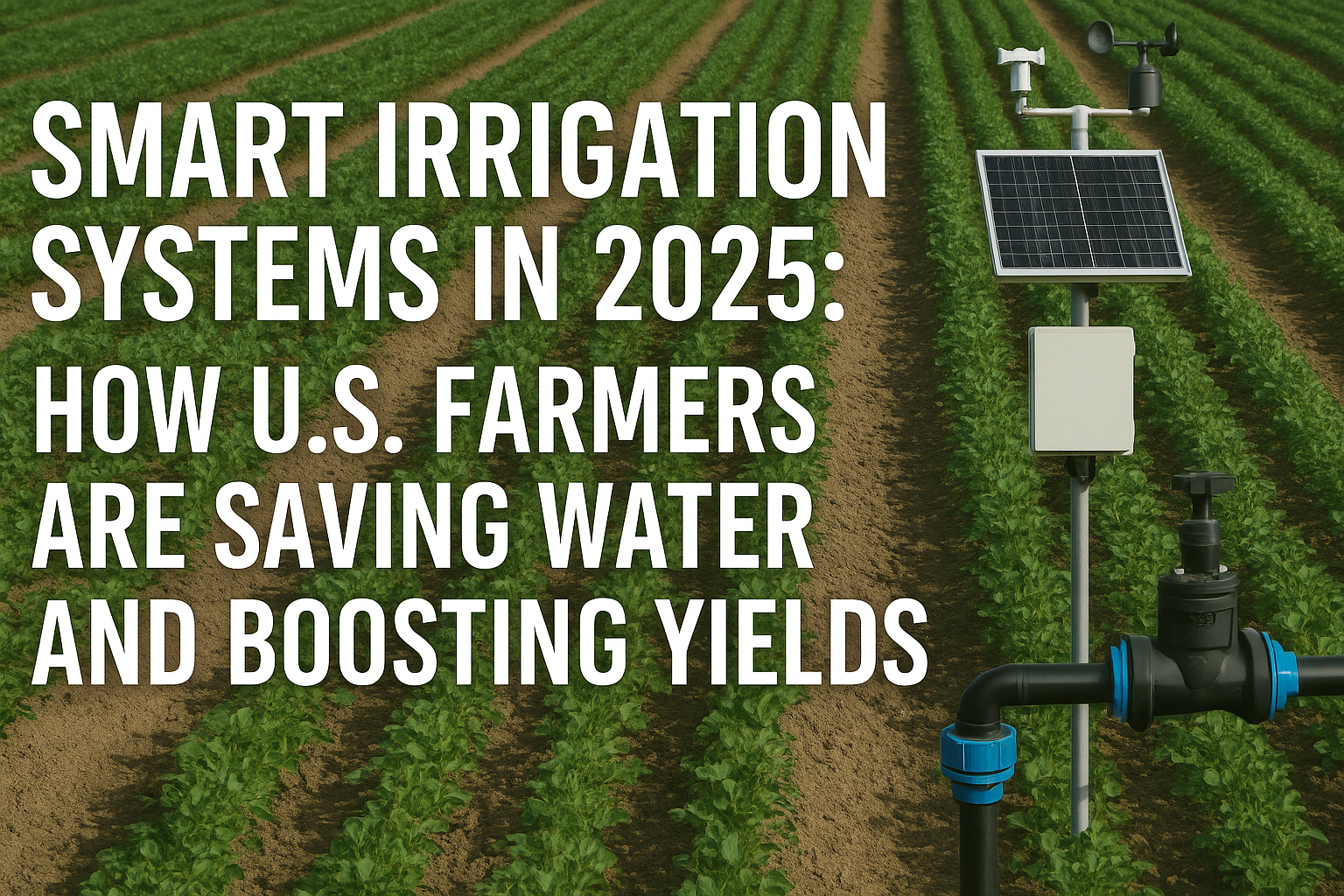
Smart irrigation refers to technology-enhanced systems that automatically adjust water application based on real-time data from soil moisture sensors, weather forecasts, evapotranspiration rates, and more.
✅ Core Components:
-
IoT Sensors – Measure soil moisture, temperature, and nutrient levels.
-
Weather Data Integration – Syncs with forecasts to prevent overwatering before rain.
-
AI Algorithms – Analyze data to make real-time watering decisions.
-
Mobile Dashboards – Allow farmers to monitor and control irrigation remotely.
Unlike traditional timer-based systems, smart irrigation adapts in real-time, helping farms save 30–50% of water on average.
Why Smart Irrigation Is Booming in 2025
1. Water Scarcity
States like California, Arizona, and Texas continue to battle droughts. With limited access to groundwater and increasing water restrictions, efficient irrigation isn’t optional—it’s survival.
2. Government Incentives
The USDA and NRCS offer grants and financial support for adopting climate-smart and water-efficient technologies, including smart irrigation systems.
3. Rising Costs
Labor and energy costs are soaring. Automated irrigation systems drastically reduce manual labor, improve efficiency, and lower energy bills.
4. Data-Driven Precision
Farmers in 2025 rely on data. Smart irrigation aligns with precision agriculture by integrating seamlessly with drones, GPS systems, and crop modeling software.
Top Smart Irrigation Technologies in 2025
🌿 1. Drip Irrigation + Sensors
Combining drip systems with soil moisture sensors enables pinpoint watering. Companies like Netafim and Toro are leaders in this space.
🌦 2. AI-Powered Irrigation Controllers
Tools like CropX, Rachio, and Jain Logic use artificial intelligence to schedule watering based on weather, soil type, and crop growth stages.
🌐 3. Wireless Soil Moisture Monitoring
Platforms such as Teralytic and Arable offer plug-and-play sensor systems that report soil health in real-time to your phone or tablet.
📡 4. Satellite + Drone Mapping
Remote sensing tools detect drought stress zones before they impact yield, allowing for site-specific irrigation.
📱 5. Cloud-Based Control Panels
Many systems now come with web or app interfaces, allowing farmers to control irrigation from anywhere—great for multi-location farms.
How Smart Irrigation Saves Water and Boosts Yields
💧 Water Savings
Smart systems often reduce water usage by up to 50%. This means less groundwater depletion and fewer over-irrigation issues like root rot and nutrient leaching.
🌾 Yield Improvement
Crops get the ideal amount of water at every growth stage, leading to better plant health, larger yields, and higher market quality.
⏱ Labor Reduction
With automation, manual valve opening and irrigation checks are minimized, allowing workers to focus on other high-value tasks.
💸 ROI and Cost Recovery
While initial costs can be high, many farmers recoup investments within 2-3 seasons, especially with access to grants and energy savings.
Real-World Case Studies (2025)
🚜 Case 1: Almond Orchard in California
A 250-acre orchard in Fresno integrated Jain Logic sensors and cut water use by 38% in a single season while increasing nut quality scores by 15%.
🌽 Case 2: Corn Farm in Iowa
A mid-sized family farm using CropX AI software improved yields by 12% and reduced water runoff issues after switching from sprinkler irrigation.
🥬 Case 3: Organic Farm in Colorado
Using solar-powered drip systems with IoT sensors, a small organic farm saved over $10,000 annually in water and labor costs.
How to Choose the Right Smart Irrigation System
🧩 1. Assess Your Water Source
Are you using groundwater, municipal water, or rainwater harvesting? Choose systems compatible with your supply type and pressure levels.
🌱 2. Know Your Crops
Different crops have different water demands. AI-driven systems can be customized for row crops, orchards, or greenhouse operations.
📏 3. Farm Size & Budget
-
Small farms: Start with moisture sensors + mobile apps.
-
Medium farms: Consider zone-based controllers.
-
Large farms: Go full-scale with cloud-based platforms and satellite integration.
🎓 4. Training & Support
Choose providers offering training, maintenance, and customer support. Many also help with grant applications.
Government Support & Grants in 2025
The U.S. Department of Agriculture (USDA), Natural Resources Conservation Service (NRCS), and local extension services offer funding under programs like:
-
EQIP (Environmental Quality Incentives Program)
-
CSP (Conservation Stewardship Program)
-
REAP (Rural Energy for America Program)
These programs can cover 30–75% of system costs, depending on location and need.
Common Challenges and Solutions
| Challenge | Solution |
|---|---|
| High upfront cost | Apply for USDA/NRCS subsidies and low-interest loans |
| Lack of technical know-how | Choose user-friendly apps and seek provider training |
| Connectivity in rural areas | Opt for LoRaWAN or solar-powered offline-compatible tools |
| Maintenance of sensors | Go for rugged, waterproof models with minimal upkeep |
Smart Irrigation + Sustainable Farming = A Win-Win
By adopting smart irrigation, farmers are not just saving water—they’re contributing to a climate-resilient, sustainable food system. The shift toward tech-driven conservation is key to ensuring food security for future generations.
Conclusion: Time to Make the Smart Switch
In 2025, water management is not just about availability—it’s about efficiency, intelligence, and sustainability. Whether you’re a small vegetable grower or managing thousands of acres, smart irrigation systems can transform your operations.
Start small or go all in—but don’t get left behind. The future of farming is smart, sustainable, and data-driven.