Farming’s Digital Leap: A New Era of Agricultural Innovation
Agriculture is no longer bound by the conventional. The dusty plow and horse-drawn carts have been replaced with AI-powered tractors, GPS-guided drones, and data-driven decision-making systems. The surge in modern farming tools has revolutionized every corner of agriculture, making it more precise, efficient, and sustainable.
Today, farming is data-rich and technology-driven. With the help of satellite imagery, machine learning, and robotics, farmers can now analyze soil conditions, monitor crop health, and apply resources with pinpoint accuracy.
Why Modern Farming Tools Are Essential in 2025
As global food demand increases, climate change disrupts patterns, and arable land becomes scarce, modern farming tools have become not just useful but essential. These tools help farmers minimize waste, increase yields, and conserve resources.
In fact, according to AgFunderNews, the agtech sector saw over $15 billion in investment in 2024, reflecting its growing significance. This momentum is reshaping how farms operate, from small family-owned plots to large-scale commercial operations.
Smart Tractors and Autonomous Machinery on the Rise
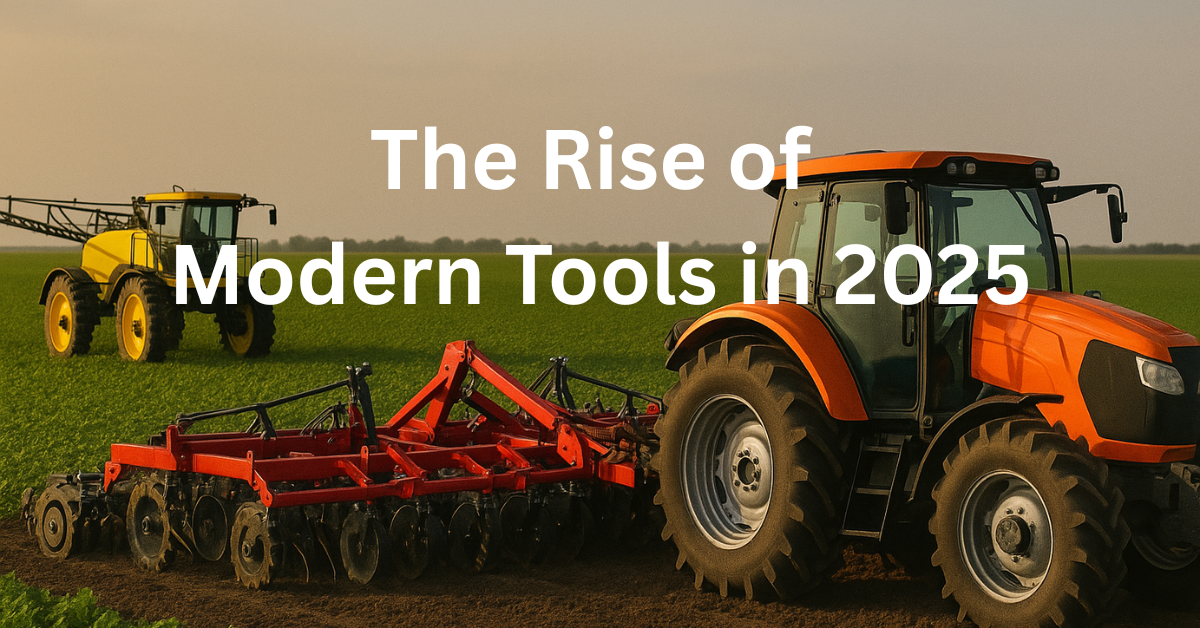
One of the most visible advancements in modern farming is the evolution of tractors and harvesters. These aren’t your grandfather’s machines. Today’s smart tractors are equipped with GPS, IoT sensors, and autonomous driving systems.
Brands like John Deere and Kubota are developing AI-powered tractors that can plant, plow, and harvest with minimal human intervention. These machines can adjust speed, pressure, and direction based on real-time field data. You can explore examples on John Deere’s innovation page.
These tools reduce labor costs and optimize efficiency, especially during peak seasons when timing is critical.
Drones: Eyes in the Sky for Every Farm
Drones have become indispensable modern farming tools for farmers in 2025. They provide aerial views of fields, identifying plant stress, pest infestations, and irrigation problems in real-time.
Multispectral imaging and thermal sensors allow farmers to detect crop issues before they become visible to the naked eye. Platforms like DroneDeploy offer farmers high-resolution maps and analytics to make data-backed decisions.
The speed at which drones gather data helps farmers respond quickly, saving crops and improving yields.
Soil Health and Sensors: The Foundation of Smart Agriculture
Healthy soil is the heart of any successful farm. With the use of modern soil sensors, farmers can now monitor nutrient levels, moisture content, pH, and temperature in real time.
Companies like CropX are pioneering smart sensors that integrate with mobile apps, helping farmers understand what their soil needs and when. These modern farming tools reduce over-fertilization and water waste, promoting both yield and sustainability.
By using this data, farmers apply inputs only where and when they’re needed, a technique known as precision agriculture.
Climate-Smart Irrigation Systems
Water is one of the most valuable and limited resources in agriculture. Traditional irrigation methods often waste water and energy. However, modern farming tools like drip irrigation systems, automated sprinklers, and smart irrigation controllers are changing that.
These tools adjust watering schedules based on weather forecasts, soil data, and plant needs. Systems such as those from Netafim allow for precise water delivery, reducing consumption and increasing effectiveness.
Such innovations are vital in drought-prone areas where water conservation is crucial for survival.
The Role of AI and Big Data in Modern Agriculture
Artificial intelligence isn’t just for tech startups. In agriculture, AI algorithms analyze field data, predict crop diseases, suggest ideal planting times, and even determine harvest readiness.
Platforms like Climate FieldView allow farmers to visualize and understand massive amounts of field data through intuitive dashboards. These tools make it easier to identify trends and take preemptive action.
Big data analytics combined with AI ensures that farms run smarter, not harder.
Robotics: The New Farmhands
Robotic technology is moving from greenhouses to open fields. Autonomous robots now perform tasks such as weeding, seeding, pruning, and even fruit picking.
These modern farming tools work 24/7 without fatigue and with surgical precision. Machines like the Naïo Oz and Agrobot have shown remarkable results in both commercial and specialty crops.
By taking over labor-intensive and repetitive tasks, robots allow farmers to focus on strategy and management rather than manual labor.
Vertical Farming and Controlled Environments
Urban spaces are being reimagined as agricultural hubs through vertical farming. Controlled environment agriculture (CEA) uses LED lighting, hydroponics, and AI to grow crops in stacked layers indoors.
Modern tools monitor light exposure, humidity, and nutrients automatically. Startups like Plenty are growing pesticide-free produce using 95% less water than traditional farms, all while being located closer to urban consumers.
This is the future for feeding growing cities with fresh, locally-grown food.
Mobile Apps for Farm Management
In today’s digital age, smartphones are as essential to farming as tractors. Mobile farm management apps help farmers track operations, manage finances, monitor crop health, and plan planting schedules.
Apps like FarmLogs give farmers real-time insights into field conditions, rainfall tracking, and planting data. With remote access to critical information, decision-making becomes faster and smarter.
Such tools empower even small-scale farmers to leverage modern farming tools without the need for huge investments.
Sustainability Through Technology
Sustainability is at the heart of modern agriculture. From reducing chemical usage to minimizing soil erosion, modern farming tools are instrumental in creating eco-friendly farming systems.
Using fewer inputs with greater results means lower environmental impact. Tools that track carbon emissions and promote regenerative farming practices are increasingly being adopted.
Agritech startups are prioritizing environmental impact alongside profitability, proving that sustainable farming is both viable and necessary.
Government Policies and Subsidies Supporting Innovation
Governments worldwide are recognizing the importance of technology in agriculture. In the U.S., programs like the USDA’s Farm Service Agency offer subsidies and low-interest loans to help farmers adopt modern farming tools.
Public-private partnerships are also funding research and providing education on how to implement smart farming techniques. Farmers now have better access to innovation than ever before.
As these policies continue to evolve, the integration of new technology into everyday farming becomes more accessible.
The Cost Factor and ROI of Modern Farming Tools
Cost remains a barrier for many, especially smallholder farmers. However, the long-term return on investment (ROI) for modern farming tools is undeniable.
Increased yields, reduced input costs, lower labor expenses, and better quality produce all contribute to profitability. With leasing options and cooperative models, even smaller farms can participate in the tech-driven future.
It’s not just about affordability — it’s about value and resilience.
Education and Training for the Future Farmer
Technology means little without people who can use it effectively. Modern agricultural education focuses on training farmers in data interpretation, app usage, and equipment handling.
Online platforms, community colleges, and extension services are all helping bridge the knowledge gap. By learning to work with modern farming tools, the next generation of farmers is better prepared to face the challenges ahead.
Knowledge is becoming the most valuable tool on the farm.
Final Thoughts: Embracing the Future of Farming
Modern agriculture is not an industry stuck in the past — it is a powerhouse of innovation. With the rise of modern farming tools, farms are becoming more productive, sustainable, and resilient in the face of global challenges.
Whether you’re a farmer, investor, policymaker, or consumer, the adoption of agtech is something that will impact us all. The journey has just begun, and 2025 is proving to be a turning point in agricultural evolution.
Frequently Asked Questions (FAQs) About Modern Farming Tools
Q1. What are modern farming tools?
A: Modern farming tools are advanced equipment and technologies designed to improve agricultural efficiency, productivity, and sustainability. These include GPS-guided tractors, drones, soil sensors, smart irrigation systems, AI-powered analytics platforms, and robotic harvesters.
Q2. How do modern farming tools improve crop yield?
A: Modern farming tools enhance crop yield by providing precision in planting, watering, and fertilizing. With tools like AI-driven sensors and data platforms, farmers can make informed decisions to apply the right amount of resources at the right time, reducing waste and increasing output.
Q3. Are modern farming tools affordable for small farmers?
A: While some high-end tools can be costly, many affordable and scalable options are available for small farmers. Government subsidies, leasing programs, and cooperative purchasing models also help reduce the cost of adoption.
Q4. What role does artificial intelligence play in modern farming?
A: AI helps analyze data collected from sensors, drones, and machinery to predict crop performance, detect diseases early, and optimize irrigation and fertilization schedules. It allows farms to operate more efficiently and make proactive decisions.
Q5. Can drones really help farmers?
A: Yes, drones are vital modern farming tools used for aerial mapping, crop monitoring, and even spraying pesticides or fertilizers. They provide real-time visuals and analytics, helping farmers detect problems quickly and accurately.
Q6. What is precision farming, and how is it related to modern tools?
A: Precision farming is a technique that uses data and technology to manage variability in the field. Modern tools like GPS systems, sensors, and farm management software enable farmers to apply inputs precisely, reducing costs and improving productivity.
Q7. Is there training available for using modern farming tools?
A: Yes, various agricultural universities, extension services, online platforms, and agtech companies offer training programs and tutorials for using modern farming tools effectively.
Q8. How do modern farming tools contribute to sustainability?
A: These tools reduce the use of water, chemicals, and fuel by optimizing input application. This minimizes environmental impact, promotes soil health, and supports long-term agricultural sustainability.smartagriculture
Q9. What is the future of modern farming tools in agriculture?
A: The future involves deeper integration of AI, robotics, IoT, and blockchain into agriculture. As these tools become more accessible and affordable, they’ll play a central role in feeding a growing population while protecting the environment.